

Cephalanthus natalensis
Author: Ivan Lätti
Photographer: Johan Wentzel
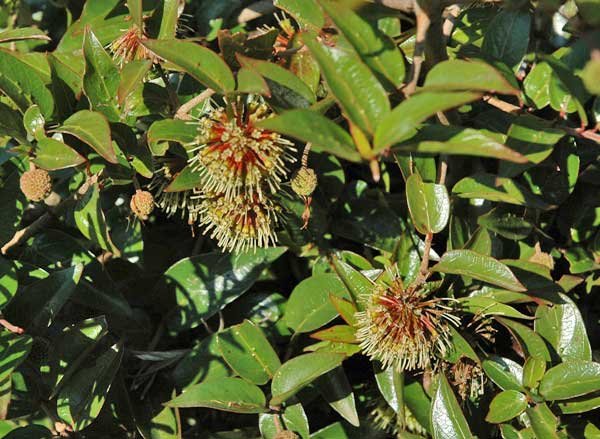
Cephalanthus natalensis, commonly known as the strawberry-bush, far far tree or quinine berry, and in Afrikaans the witpruim (white plum), is a scrambling shrub, sometimes a liane of forest canopies, or a small tree reaching heights from 4 m to 8 m (SA Tree List No. 685). It branches from low down, the stem often short, the many branches arching. The smooth bark is grey to brown, sometimes vertically striated, with raised, white lenticels on young stems that start off hairy. Although the genus is not monotypic this is the only species growing naturally in South Africa.
The rounded fruits cohere in a strawberry-like cluster, white, pink or red in colour and 2 cm in diameter. The divided segments are one-seeded, visibly bulging on the fruit surfaces. The seeds are ovate in outline, convex on one side, flat on the other.
The species distribution is from the east of the Eastern Cape and KwaZulu-Natal to the east of Mpumalanga and Limpopo, as well as in some neighbouring countries.
The habitat is higher elevation montane forests, their margins, on rocky outcrops, and in high rainfall grassland. The habitat population is deemed of least concern early in the twenty first century.
The fruits are commonly eaten by people, animals and birds, sometimes made into a jam. The leaves are browsed. The plant's medicinal use in treating fevers is questioned. The tree can be grown from seed, is suitable for gardens (Coates Palgrave, 2002; Schmidt, et al, 2002; Van Wyk and Van Wyk, 1997; Pooley, 1993; iNaturalist; http://redlist.sanbi.org).