Albums
Salvia chamelaeagnea
Author: Ivan Lätti
Photographer: Thabo Maphisa
Salvia chamelaeagnea, sometimes called the rough blue sage and in Afrikaans the Afrikaanse salie (Afrikaans salvia) and the bloublomsalie (blue flower salvia), is a much-branched greyish shrub reaching heights to around 2 m. The stems are four-sided or square in cross-section.
The opposite leaves are hairless, leathery and gland-dotted, more rough than hairy. The paddle-shaped blades are sometimes toothed along the margins.
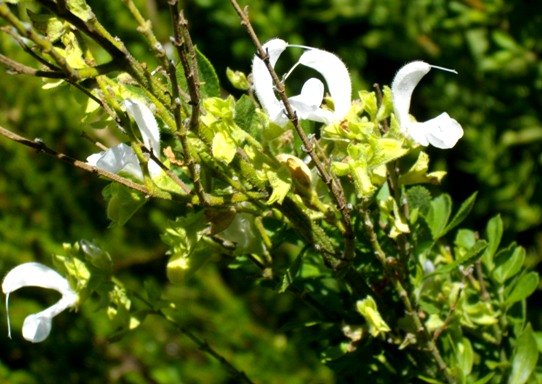
The flowers are usually blue, mauve or pink, but may occasionally be white as in the photo, borne at the tips of leafless branchlets. Two-lipped flowers, up to 2,8 cm in length, grow in whorls. The upper lip is longer, the stamens protruding from below the hood of this upper lip. The hairy calyx enlarges at the end of the flowering phase to hold the fruit. Flowering commences late in spring and continues until autumn.
The plant occurs from the far southwest of the Northern Cape to the Cape Peninsula in the Western Cape and eastwards to Oudtshoorn in the Little Karoo and Riversdale near the coast.
The habitat is fynbos and shrubland flats and slopes of sandstone and granite. The habitat population is deemed of least concern early in the twenty first century (Manning, 2009; Bean and Johns, 2005; iNaturalist; iSpot; https://redlist.sanbi.org).