
Albums
Oxalis truncatula
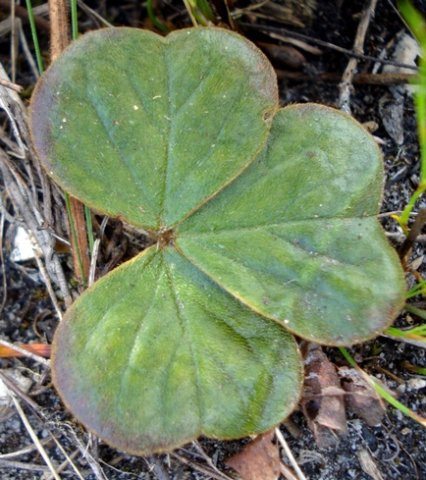
Author: Ivan Lätti
Photographer: Judd Kirkel Welwitch
Oxalis truncatula, sometimes called the fynbos sorrel, is a stemless perennial that may reach 12 cm in height, sometimes only half that.
The leaves growing from the base in a tuft are divided into three leaflets, borne horizontally on no petiolules (leaflet stalks), meaning sessile or stalkless. The petioles (leaf stalks) are short, sturdy and hairy, emerging from the ground. The nearly round to heart-shaped leaflets may be flat to slightly notched at the tip, tapering at the base. The dark green, leathery blades are often glossy. They have sunken midribs and secondary venation, the about three ascending lateral veins branching near the margins. The surfaces may be hairy, often not but usually coarse. There is a hint of reddish colouring near some margin parts in the photo. The leaflets may be 4 cm in diameter.
The specific name, truncatula, is a Latin word meaning minutely truncated, referring to the slightly cut off or squared appearance of the leaflet tips.
The species distribution is in the southwest of the Western Cape, ranging from Paarl and Caledon to Bredasdorp. This leaf was spotted in Fernkloof in October when no flowering of this plant should be expected.
The habitat is stony mountain slopes on hard ground. The habitat population is deemed of least concern early in the twenty first century (Curtis-Scott, et al, 2023; Bean and Burman, 1985; Bond and Goldblatt, 1984; iNaturalist; iSpot; https://redlist.sanbi.org).