
Albums
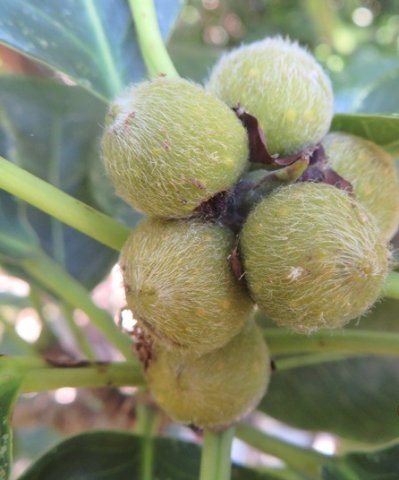
Ficus burkei figs or syconia
Author: Ivan Lätti
Photographer: Francelle van Zyl
The fruits of Ficus burkei are small figs borne solitary or in pairs from leaf axils. The figs are stalkless or sometimes on the shortest of stalks. These fruits are often aggregated in dense clusters among the leaves near stem-tips.
The globose fig or syconium is initially pale green, grey green or yellow green, maturing at about 1 cm in diameter, and often becoming reddish when ripe. Syconia usually start off hairy. Their whitish hairs may diminish or disappear as they ripen. Basal bracts, small and hard, are visible below the figs in picture, standing out quite clearly as dark scales. These bracts are not always equally visible, but feature more in this species than in some other species. All fig trees have some kind of bracts that initially enfold the fruit growth beginnings. The figs seen on a tree may be doubled in size when galls form inside them, triggered by certain wasps.
Fig wasps are big in fig tree life. No less than 28 species of tiny wasps are known to live with trees of the F. thonningii complex that includes F. burkei. The wasps pollinate the internal florets of the syconium, the fig, while reproducing their own next generation of wasps there. Some of these wasp species only use this kind of fig tree. Some fig tree species have only one dedicated wasp visiting it, the two species in an exclusive, reproductive symbiosis. Coates Palgrave tells a fascinating tale about wasp doings inside figlet haunts or syconia.
Maybe multispecies arrangements, as in the F. thonningii complex, could facilitate wider spread of the trees into different ecological settings, and therefore geographical regions via the benefit of different pollination partner options (Coates Palgrave, 2002; Schmidt, et al, 2002; Van Wyk and Van Wyk, 1997; Pooley, 1993; iNaturalist; Wikipedia).